
I met today’s guest at an author expo at my local library. Like myself, she is a Michigan author.
Cynthia was a delight to have as my next-table neighbor. I got to know some of her life story that day, but I wanted to find out more. So today Cynthia joins me to talk about her novel: The Surface of Water.
Cynthia, it was great to meet you in person. Thank you for being my guest today. Let’s start by you telling us a little bit about yourself:
For thirty years I was a busy professor of creative writing and English. My job let me be a student of writing. Not only did I have to read a flood of writing books, but I could learn about process strategies—that is, how to do our writing—as I watched my students struggle or shine.
In the cracks, I wrote both nonfiction and fiction. With a journalism master’s, I contributed to books like Media Ethics and Zondervan’s grief bible, Hope in the Mourning.
I also drafted novels, which was my happy place. Later in life, I did a Master of Fine Arts in fiction craft. This degree gave me strong tools for story craft.
Creative Juices for Writers, second edition, is my book on writing that focuses on story power, process tools, and soul care.
Let’s take a look at your novel, The Surface of Water. What can you tell us about this story?
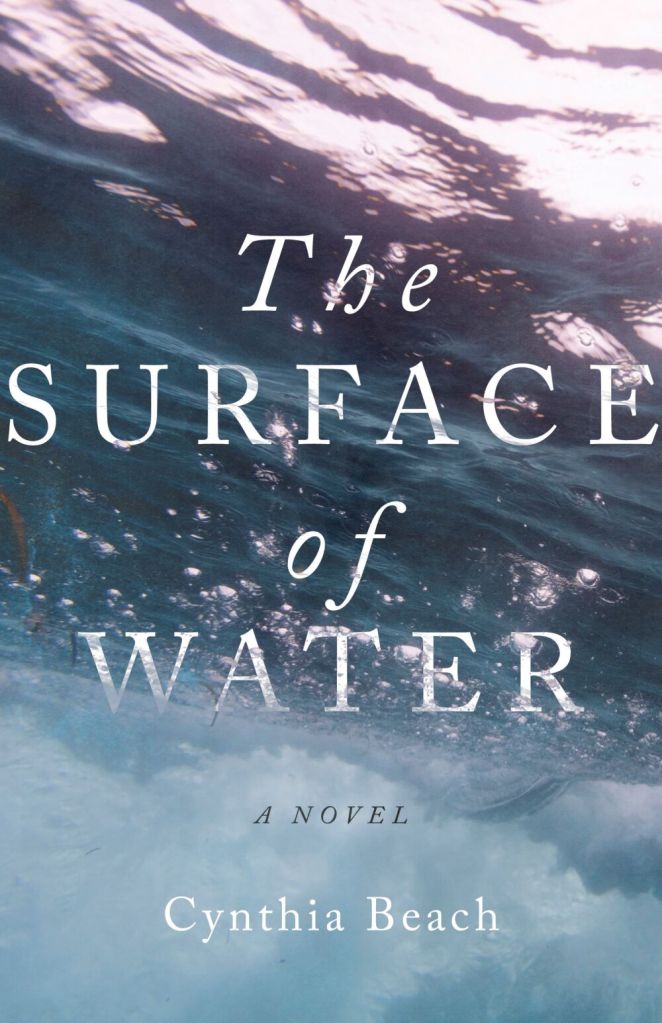
The only person who can uncover his secret has arrived.
Matthew Goodman is tired, and his one wish is for something he can’t have. Instead, he focuses on his work as pastor of Chicagoland’s Calvary Community, including hiring new administrative assistant, Trish Card. Trish watches him with somber, lake-clear eyes. What he doesn’t know about Trish and her real reason for appearing will dismantle his world.
The Surface of Water is about a megachurch pastor, a famous evangelist’s son, living in a world beyond his control. It’s also a story about a young woman trying to understand her complicated life. In the #ChurchToo era, this novel invites readers to see life’s shadowed edges—isolation, power, and abuse—illuminated by the light of truth.
What is the inspiration behind The Surface of Water?
When I was in high school, English teacher Mrs. Quinn taught me the E.A. Robinson poem, “Richard Cory.” This short poem shook my world. Why? Because Richard Cory was the town celebrity: handsome, rich, mannered. People envied him. They wanted to be him. And at the end of the poem—Richard Cory suicides.
I didn’t know. Someone who seemed to have it all together may not. That person who seems to have it all may have a very different internal experience. Richard Cory haunted me. Then, probably twenty years later, the question arrived: What if a megachurch pastor was a Richard Cory?
I find it’s difficult to set aside time to write. How do you find time in your day to write?
Before I left teaching this past June, I had little free time. I was grading writing after all. But what helped me complete The Surface of Water was this simple trick: small goals. I did not have blocks of time. Few of us do, right? But I could write 350 words four times a week or proofread 25 pages a week. Small specific goals energized me—I could do them. And small specific goals gave me another benefit: I knew when I was finished.
Do you reward yourself when a book is finished? If so, what is your favorite treat?
For sure! Celebrating our accomplishments is vital, me thinks, so, when I finished edits on Surface, I gobbled up a hot fudge peanut parfait. De-lish!
Who was your favorite character to create?
Instead of one favorite character, what was utterly fascinating to me was seeing the same events through different characters’ eyes. I loved moving from Matthew Goodman’s point of view to Trish’s. The fiction term is “viewpoint character.” A trend these days is to have multiple viewpoint characters, which is as interesting to read as it is to write.
Are you a plotter or a panster?
I write where my ideas are clear—with little or no planning. This puts me squarely in the Pantser Mode. The catch? While I draft quickly, I revise long because I have such a mess. I found I needed to strengthen my Pantser Process by taking a small step toward Plotter Mode. NYT bestselling novelist Elizabeth George, a devout plotter, offers many planning tools in her writing book, Write Away. Doing scratch outlines of plot flow served a pantser like me well.
Do you experience writer’s block? What do you do to get through it?
For me, block occurs because I’m feeling unsure either from a lack of needed research or from fear. As a pantser, I postpone most research until after my first draft when I know what I need. The weakness, of course, is that I need to tweak subplots. But research always helps me find my way.
Fear desires to hamstring my writing. Thankfully, Julia Cameron’s The Artist Way helped me recognize when fear is talking. A more recent helpful habit I’ve found is to journal my fears. Writing about what I’m feeling and perhaps why diffuses the block, and I’m free to move forward.
What’s next for you as an author?
My novel The Surface of Water ends with characters Matthew and Trish in jeopardy. What happens next? In answer, I’m happily researching and revising the sequel, A Thousand Wings of Light.
Just slightly off stage await my two Irish novels—historical fiction, a first for me. I drafted two novels for The Seaborne Series. Recent local events like Ada’s Fur-Trapper Encampment delivered very helpful research. From the descendant of the famous settler Rix Robinson, I learned how to twist rope from plants. This stirs the fire. I can’t wait to return full-throttle to this series. Of course, I’ll need to figure a way to get myself back to Castlerock, N. Ireland.
Cynthia, thanks so much for doing this interview with me. Before we go, where can readers find you online?
CynthiaBeachAuthor on Instagram
Here is a link to buy Cynthia’s book:
 Inspirational Author