We hear and read a lot about of the End of the World. Many think it is close. That we are seeing the Book of Revelations played out before our eyes.
This causes unrest among God’s people when it should really be something we are looking forward to. To hear the trumpet call and see our Savior coming through the clouds of glory.
What are we afraid of?
The unknown?
When I was in sixth grade, the year was 1976. A friend told me that they’d dug up an old man’s body and he said the world was going to end in two years. From 1976 to 1978 I lived in fear that the world was coming to an end. Around that time at church camp we watched the original Left Behind movie and it was terrifying.
When the Left Behind book series and the remake of Left Behind came out when my older two were kids, I didn’t read the books with them or have them watch the movie.
But a few years ago I took my younger son to see the latest release of Left Behind in the movie theater. As we sat there, he watched the first few minutes and I could see that he was terrified so we left.
As I grow older and my faith in God grows deeper, I have come to realize that it is nothing to fear. Not for believers. My only fear is that my loved ones will not be ready. Should I try harder to witness to them about salvation because the end of the world could be near?
I don’t believe that’s the way to reach our loved ones for Christ. We shouldn’t want them to come to the Lord through fear. Rather, they should see love and mercy play out in our relationships with them and encourage them to consider salvation. Yes, we need to invite them to church and share our testimony when it is appropriate. But we can’t force them into a decision for Christ through the power of fear.
I’m not afraid of the end times, as I was in my childhood and teen years. I know the end of this world will not be the end of life. As God is eternal, so our souls are eternal as well. Whatever happens to me in this life, I am ready to spend eternity with the Maker of Heaven and Earth.
If it means I am to suffer for being a Christian, I’m ready to stand up for my faith. God has never let me down. He is always with me, and will be with me through anything life has to throw my way. Human uncertainty creeps in sometimes, but faith in a loving God eradicates that fear in anticipation of being with our Heavenly Father.
As I grow older, I find myself looking forward to the day when I shall meet Jesus face to face. All my tears will be wiped away. The tapestry that looks snarled and tangled underneath will be a beautiful scene from heaven. Then I will understand all the twists and turns, the heartaches and sorrows in my life.
When the day comes when Jesus shall return to earth, the world as we have known it will cease to exist. But even then, that is not the end of life.
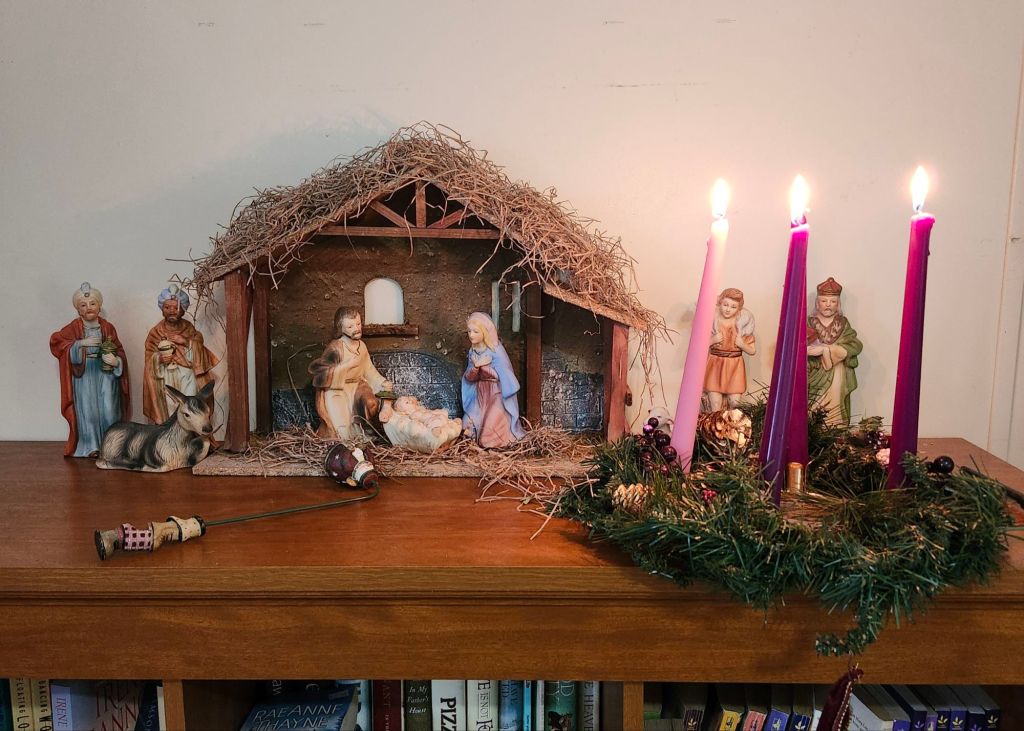
Having an Advent wreath in my home is something that I didn’t start until a year or two after my husband passed away. At the time, I was looking for a way to make Christmas more meaningful to my son, who was in elementary school at the time. So I bought an Advent wreath. It was plain with brackets for the candles, so I made it more festive with fake greenery I had on hand.
I purchased the candles as a set. I bought a long lighter and a candle snuffer so my son could participate in the lighting of the candles. (His favorite part being “unlighting” them.)
For a few years, we did this together, then he reached his teens and no longer cared to participate.
I continued setting up my Advent wreath at Christmastime and lighting the candles each year. (I always have to dig out the little pamphlet that tells what each candle means, but that’s okay.)
I’m not always a frugal person, but in this instance, I was. Year after year I used the same candles until they were melted down about halfway.
This year I decided it was time for new candles. I ordered some online.
When they arrived I was disappointed that one had cracks in it. And they didn’t quite fit my wreath.
As you can see from the picture above, they are leaning a little.
This year it was hard for me to think about lighting the candle for Joy. We’ve experienced loss in our extended family and a very dear friend also began her journey with grief. I didn’t really feel the joy of the season, so I didn’t light the candle.
Now it was nearly the close of the third week of Advent. And I still had not lit my candles.
Today, as I went about my day, the words of the song, “Through all of It” by Colton Dixon kept coming to me.
(I’ll post the link to the YouTube video below).
The lyrics that were running through mind are:
“I have Won, I have Lost, I got it right but sometimes I have not. Life’s been a journey, I’ve seen joy, I’ve seen regret, but You have been my God through all of it.”
I played the song on my music app. I read the lyrics as I listened.
After listening to the whole song, I was inspired to light my Advent candles.
I lit the candles for Hope, Peace, and yes, I even lit the candle for Joy (The pink one).
The words of the song are so true. My life has been a journey. There’s been times of both joy and pain, it seems, and oh so many regrets.
As you can see in the photo, my candles are leaning a little. My Joy candle is not very strong in its position.
Sort of like my emotions this year.
My Joy is faltering a little. It isn’t very strong.
But I was still able to light it, and while leaning, the candle is secure in its brass holder. (Like we are in God’s love.)
It was only lit for a minute or two, while I played through the song, “Through all of It.”
By taking this moment in my day to focus on the reason for this season, I felt hope that there will again be joyous celebrations ahead.
As promised, here is a link to the Lyrics video on YouTube, “Through all of It” by Colton Dixon.
I met today’s guest at an author expo at my local library. Like myself, she is a Michigan author.
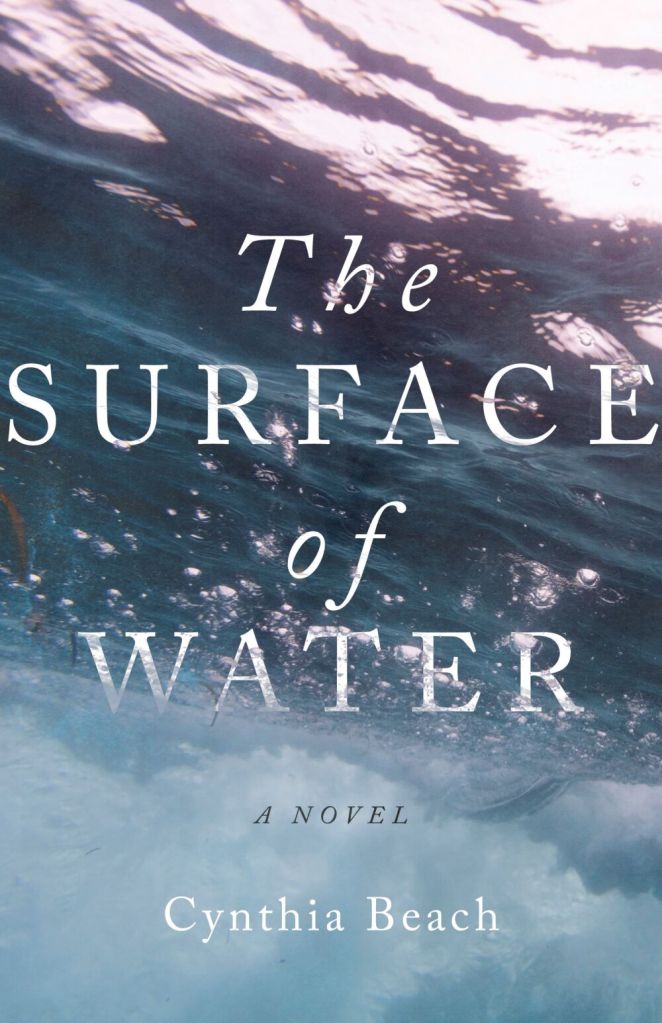
Cynthia was a delight to have as my next-table neighbor. I got to know some of her life story that day, but I wanted to find out more. So today Cynthia joins me to talk about her novel: The Surface of Water.
Cynthia, it was great to meet you in person. Thank you for being my guest today. Let’s start by you telling us a little bit about yourself:
For thirty years I was a busy professor of creative writing and English. My job let me be a student of writing. Not only did I have to read a flood of writing books, but I could learn about process strategies—that is, how to do our writing—as I watched my students struggle or shine.
In the cracks, I wrote both nonfiction and fiction. With a journalism master’s, I contributed to books like Media Ethics and Zondervan’s grief bible, Hope in the Mourning.
I also drafted novels, which was my happy place. Later in life, I did a Master of Fine Arts in fiction craft. This degree gave me strong tools for story craft.
Creative Juices for Writers, second edition, is my book on writing that focuses on story power, process tools, and soul care.
Let’s take a look at your novel, The Surface of Water. What can you tell us about this story?
The only person who can uncover his secret has arrived.
Matthew Goodman is tired, and his one wish is for something he can’t have. Instead, he focuses on his work as pastor of Chicagoland’s Calvary Community, including hiring new administrative assistant, Trish Card. Trish watches him with somber, lake-clear eyes. What he doesn’t know about Trish and her real reason for appearing will dismantle his world.
The Surface of Water is about a megachurch pastor, a famous evangelist’s son, living in a world beyond his control. It’s also a story about a young woman trying to understand her complicated life. In the #ChurchToo era, this novel invites readers to see life’s shadowed edges—isolation, power, and abuse—illuminated by the light of truth.
What is the inspiration behind The Surface of Water?
When I was in high school, English teacher Mrs. Quinn taught me the E.A. Robinson poem, “Richard Cory.” This short poem shook my world. Why? Because Richard Cory was the town celebrity: handsome, rich, mannered. People envied him. They wanted to be him. And at the end of the poem—Richard Cory suicides.
I didn’t know. Someone who seemed to have it all together may not. That person who seems to have it all may have a very different internal experience. Richard Cory haunted me. Then, probably twenty years later, the question arrived: What if a megachurch pastor was a Richard Cory?
I find it’s difficult to set aside time to write. How do you find time in your day to write?
Before I left teaching this past June, I had little free time. I was grading writing after all. But what helped me complete The Surface of Water was this simple trick: small goals. I did not have blocks of time. Few of us do, right? But I could write 350 words four times a week or proofread 25 pages a week. Small specific goals energized me—I could do them. And small specific goals gave me another benefit: I knew when I was finished.
Do you reward yourself when a book is finished? If so, what is your favorite treat?
For sure! Celebrating our accomplishments is vital, me thinks, so, when I finished edits on Surface, I gobbled up a hot fudge peanut parfait. De-lish!
Who was your favorite character to create?
Instead of one favorite character, what was utterly fascinating to me was seeing the same events through different characters’ eyes. I loved moving from Matthew Goodman’s point of view to Trish’s. The fiction term is “viewpoint character.” A trend these days is to have multiple viewpoint characters, which is as interesting to read as it is to write.
Are you a plotter or a panster?
I write where my ideas are clear—with little or no planning. This puts me squarely in the Pantser Mode. The catch? While I draft quickly, I revise long because I have such a mess. I found I needed to strengthen my Pantser Process by taking a small step toward Plotter Mode. NYT bestselling novelist Elizabeth George, a devout plotter, offers many planning tools in her writing book, Write Away. Doing scratch outlines of plot flow served a pantser like me well.
Do you experience writer’s block? What do you do to get through it?
For me, block occurs because I’m feeling unsure either from a lack of needed research or from fear. As a pantser, I postpone most research until after my first draft when I know what I need. The weakness, of course, is that I need to tweak subplots. But research always helps me find my way.
Fear desires to hamstring my writing. Thankfully, Julia Cameron’s The Artist Way helped me recognize when fear is talking. A more recent helpful habit I’ve found is to journal my fears. Writing about what I’m feeling and perhaps why diffuses the block, and I’m free to move forward.
What’s next for you as an author?
My novel The Surface of Water ends with characters Matthew and Trish in jeopardy. What happens next? In answer, I’m happily researching and revising the sequel, A Thousand Wings of Light.
Just slightly off stage await my two Irish novels—historical fiction, a first for me. I drafted two novels for The Seaborne Series. Recent local events like Ada’s Fur-Trapper Encampment delivered very helpful research. From the descendant of the famous settler Rix Robinson, I learned how to twist rope from plants. This stirs the fire. I can’t wait to return full-throttle to this series. Of course, I’ll need to figure a way to get myself back to Castlerock, N. Ireland.
Cynthia, thanks so much for doing this interview with me. Before we go, where can readers find you online?
I recently met Susan at an author event near my hometown in Michigan. Susan, it was a pleasure to meet you and learn about your book. Thank you for joining me on my blog today.
Tell us a little bit about yourself.
I am a homegrown Michigan author with a not so common story. This may surprise you, but becoming an author wasn’t on my bucket list. I didn’t intend to write books. But when the need arose in our family (we adopted 3 children from Russia within 5 years) writing, researching, interviewing, and the hope to offer help to our family and others urged me forward. In the beginning, I knew very little about what was involved in writing a book, such as taking an idea to the page and then to a publisher. All this felt a bit overwhelming. I had to learn how to write creatively. I didn’t know what I didn’t know. Eventually, I signed up for a writing class and then another, junior and senior level courses I could take at a local college. It was a writing game changer. I guess you can say I am persistent, if anything, and that’s a good attribute for being a writer.
What is your book about?
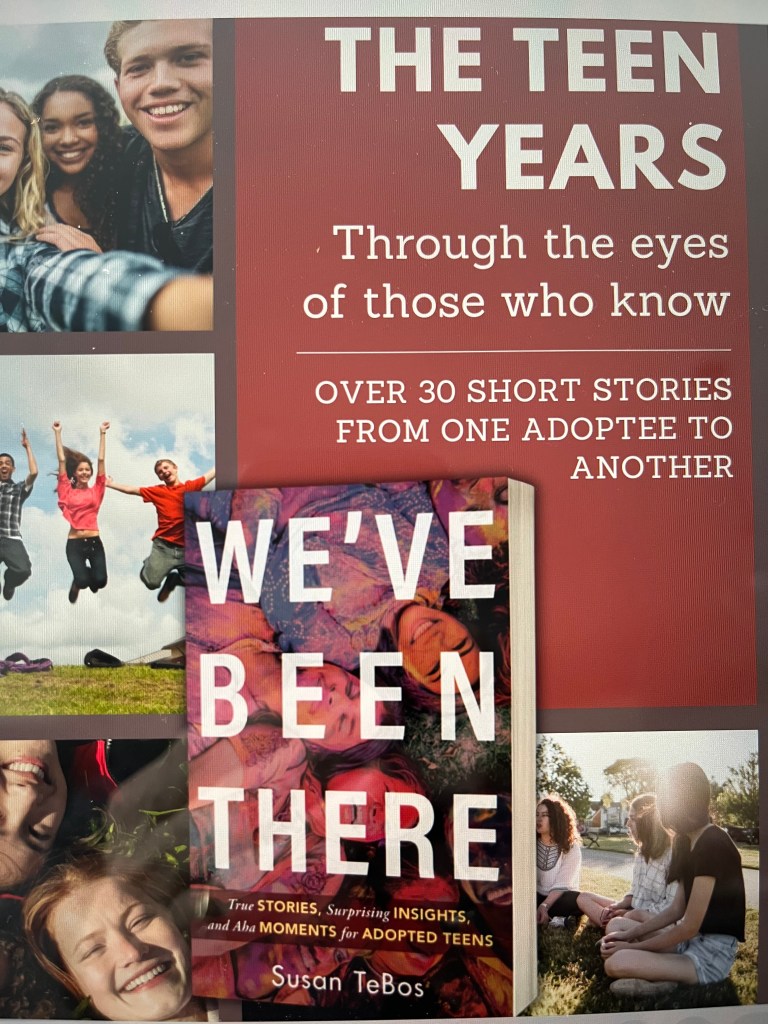
My recent book is for adoptive and foster families and anyone who wants to understand the heart of an adoptee. It’s called We’ve Been There: True Stories, Surprising Insights, and Aha Moments for Adopted Teens. I believe that every adopted child reflects on their adoption and needs guidance to process and express their emotions and thoughts. If not, many feel isolated as they ponder what happened to them, their self-worth and identity.
My favorite thing about this book is the interviews. This is a collection of 34 stories told to me by teenage and young adult adoptees from around the United States. They open up about things that they rarely talk about and things they wished others would have told them. Plus, they offer encouragement and some good advice for teens on their own journey of self-discovery and healing from loss. I learned so much from these amazing people.
What did your family think about you writing this book?
My daughter, who was adopted at 18 months, was 17 years old at the time I was researching and writing this book. Imagine a teenager hovering close by, sometimes reading over my shoulder while I was typing up the interviews. That says a lot. She longed to know what adoptees like her were experiencing and how they were handling things. One day I asked her if she’d share a story, and she leaped into the air yelling yes!! She had her own story to share about grieving her birth family that she felt others would resonate with. Two of my three kids contributed stories.
The collection is written in a journalistic style. It is written for adoptees first, but also for families and anyone who wants to understand the heart of an adoptee.
Who would like your book?
There are millions of people with adoption or foster care in their story, so many of us are connected or know someone that is adopted. Additionally, counselors, social workers, therapists, adoption agencies, church adoption ministries, libraries, families, grandparents, and of course adopted people of all ages.
How do you find time in your day for writing?
Set small goals. 300 words a day. I commit to 300 words each day of the week even if I don’t feel like it or have nothing to say. From my experience, if I can free write crappy copy 300 words this exercise turns into 700 words or more. Goal setting like this keeps me accountable.
Are you part of a writing group?
Not formally. Mostly, I have writer friends that like to meet for coffee and talk about everything from writing to platform to book proposals to selling books. Being in a community is helpful, even if it is informal.
Do you have a favorite author or book?
My favorite genre is historical fiction, regency period. Jane Austin and books like hers serve as a retreat for me. I get lost in the pages and time slips away. My brain cells appreciate it. I also read books like A Gentleman in Moscow.
Have you experienced writer’s block? If so, what do you do to get through it?
Yes, I do get blocked. There are a few things that help me. I free write with a prompt. Just stream of thought. No edits. Just move the pen on paper. It works. Also, I have paper and a pen next to my bed. It is common for me to have some pretty great ideas appear at 3:00 am
What’s next for you as an author?
I currently don’t have a book idea. However, I’m writing a couple of articles here and there for publication, and trying to improve my book visibility on my website. I also am a podcast guest and speak at adoption and foster care conferences.
Susan, thank you so much for being my guest today. Before we go, where can readers find you online?